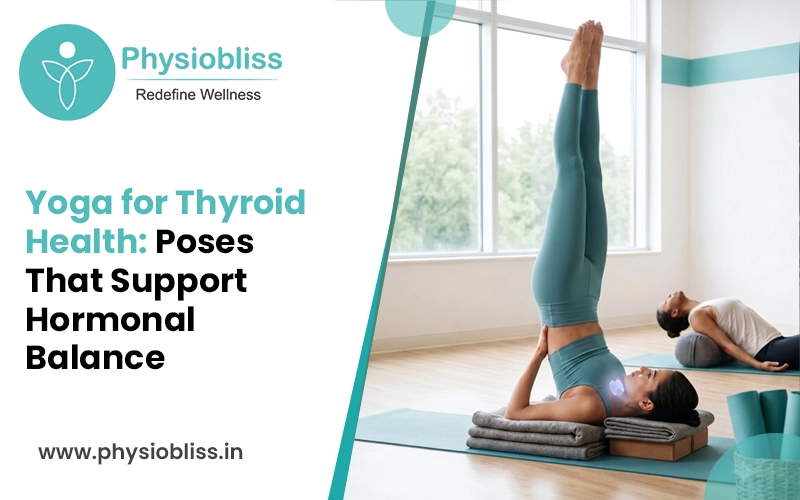
Quick Overview: Your thyroid is a small gland with an enormous job, and stress is one of its biggest enemies. Here's how a consistent yoga practice can support thyroid function, calm the stress response, and help you feel like yourself again.
Tiredness that sleep doesn't fix. Unexplained weight changes. Hair thinning, mood dips, feeling cold when nobody else is. If any of this sounds familiar, you're not alone. Thyroid imbalances are among the most common hormonal conditions in India, and they affect women far more often than men. The thyroid, a small butterfly-shaped gland at the base of your neck, produces hormones that regulate metabolism, energy, body temperature, and mood. When it slows down (hypothyroidism) or speeds up (hyperthyroidism), the whole body feels it.
Medication prescribed by your doctor is the foundation of thyroid treatment. But alongside it, there is a supportive practice that costs nothing, takes twenty minutes a day, and works on the very systems that influence thyroid function: Yoga for thyroid. Let's explore the benefits of Yoga for thyroid health and support hormonal balance.
How Does Yoga Support Thyroid Health?
The thyroid is a small, butterfly-shaped gland that sits at the front of your neck, just below the Adam's apple. Small as it is, it acts as the body's metabolic thermostat: it produces the hormones thyroxine (T4) and triiodothyronine (T3), which control how fast every cell in your body uses energy. Metabolism, heart rate, body temperature, digestion, skin and hair health, mood, memory, all of it runs on thyroid hormones. The gland itself takes instructions from the brain via TSH (thyroid-stimulating hormone), which is why a simple TSH blood test is usually the first check your doctor orders. At Physiobliss, a Yoga center in Vadodara, we emphasize some lifestyle changes and Yoga practice to help patients manage thyroid.
Thyroid problems typically show up in one of two ways:
- Hypothyroidism (underactive thyroid): The gland produces too little hormone, slowing everything down - persistent fatigue, weight gain, feeling cold, constipation, dry skin, hair fall, low mood, and brain fog. This is by far the more common form in India.
- Hyperthyroidism (overactive thyroid): The gland produces too much hormone, speeding everything up, causing unexplained weight loss, a racing heart, anxiety, tremors, heat intolerance, and disturbed sleep.
Thyroid in Women: Why It Deserves Special Attention
Thyroid problems in women are significantly more common than in men, but women are several times more likely to develop a thyroid disorder in their lifetime. The main reason is that the most frequent causes, Hashimoto's thyroiditis (leading to hypothyroidism) and Graves' disease (leading to hyperthyroidism), are autoimmune conditions, and autoimmune disorders disproportionately affect women's health.
Thyroid symptoms in women also extend beyond the general list. Because thyroid hormones interact closely with the female reproductive system, an imbalance can cause irregular or heavy periods, difficulty conceiving, worsened PMS, and hair thinning symptoms that are easy to dismiss or misattribute. The risk also rises at hormonal turning points in a woman's life: puberty, pregnancy, the postpartum months (postpartum thyroiditis), and menopause. Thyroid imbalance in women often travels alongside conditions like PCOD/PCOS as well, which is why a complete women's-health view rather than treating symptoms.
How Does Yoga Support Thyroid Health & Hormonal Regulation?
The thyroid gland does not work alone. It takes orders from the brain through the hypothalamus-pituitary-thyroid axis. This is the same communication network that chronic stress throws out of balance. Yoga supports thyroid health by reducing cortisol, lowering inflammation, improving blood circulation to the neck area and activating the parasympathetic nervous system.
6 Best Yoga Poses That Support Thyroid Health
Practice these Yoga poses on an empty stomach, on a non-slip mat, while moving slowly with your breath.
#1 Sarvangasana (Shoulder Stand)
- Lie on your back with arms alongside your body, palms down
- Exhale and lift legs at a 90-degree angle, then raise your hips and torso, stacking vertically, with weight resting on your shoulders and upper arms, not on your necks
- Keep your gaze at your toes and breathe steadily for 20–30 seconds to begin with.
- Come down slowly, one vertebra at a time.
Why it Helps: The chin gently presses toward the chest, creating mild compression around the throat region and increasing blood flow to the thyroid area. At our Yoga classes Vadodara, we consider the most important asana for thyroid stimulation.
#2 Halasana (Plough Pose)
- From shoulder stand (or lying on your back), slowly lower your legs over your head.
- Let your toes touch the floor behind you, keeping your legs straight.
- Support your back with your palms, or interlace fingers on the floor.
- Hold for 15–30 seconds, breathing slowly, then roll down with control.
Why it Helps: Deepens the gentle throat compression of the shoulder stand while calming the nervous system, a classic pairing for thyroid-focused practice.
#3 Matsyasana (Fish Pose)
- Lie on your back, legs extended, hands tucked palms-down beneath your hips.
- Press into your elbows, lift your chest, and arch your upper back.
- Gently drop the crown of your head toward the floor, opening the throat.
- Breathe deeply for 20–30 seconds, then lift your head slightly and lower it.
Why it Helps: It is the perfect counter-pose to shoulder stand and plough. It stretches and opens the throat region, balancing the compression of the previous poses and improving circulation to the neck.
#4 Setu Bandhasana (Bridge Pose)
- Lie on your back, knees bent, feet hip-width apart and close to your hips.
- Press through your feet and lift your hips toward the ceiling.
- Roll your shoulders under and interlace your fingers beneath you, chin gently tucking toward the chest.
- Hold for 30 seconds with slow breaths; lower down gradually.
Why it Helps: A beginner friendly Yoga pose for thyroid that combines gentle chin-to-chest action with chest opening, supporting thyroid circulation while strengthening the back and easing stress.
#5 Ustrasana (Camel Pose)
- Kneel with knees hip-width apart, thighs vertical.
- Place your palms on your lower back, fingers pointing down, and lift your chest.
- Slowly arch back; if comfortable, reach for your heels one hand at a time.
- Let your head drop back gently only if your neck allows. Hold 15–20 seconds.
Why it Helps: A deep front-body stretch that opens the throat and chest, stimulates circulation in the neck region, and energises the body, useful for the sluggishness of an underactive thyroid.
#6 Viparita Karani (Legs-Up-The-Wall-Pose)
- Sit sideways next to a wall, then swing your legs up as you lie back.
- Rest your legs vertically against the wall, arms relaxed by your sides.
- Close your eyes and breathe slowly for 3–5 minutes.
Why it Helps: A gentle, restorative inversion that offers many benefits of the shoulder stand improves circulation and deep nervous-system relaxation with almost none of the risk. Ideal for beginners, seniors, and anyone for whom Sarvangasana isn't suitable.
How to Practice These Yoga Poses for Real Results?
- Consistency: Twenty minutes daily will do more for hormonal balance than a two-hour session once a week.
- Pair with Medical Treatment: As a trusted physiotherapist in Vadodara, Dr.Richa Goswami at Physiobliss emphasize the importance of pairing Yoga with prescribed medicines and regular thyroid tests.
- Learn from Certified Instructors: Practising these Yoga poses under a certified instructor ensures proper alignment and safe poses.
At Physiobliss, a physiotherapy centre in Vadodara, our sessions are led by Dr. Richa Goswami (MPT Ortho, YTTC), who brings physiotherapy expertise and certified Yoga training in every session. For women managing thyroid issues alongside PCOD, PCOS, or menstrual concerns, our women's health programmes integrate yoga into a complete, personalised wellness plan, with weight management support when thyroid-related weight change is part of the picture.
Practice Thyroid-Friendly Yoga in Vadodara
Physiobliss offers certified Yoga and physiotherapy sessions in Vadodara, led by Dr. Richa Goswami. 203-204, 2nd floor, Neelkanth Gold, Vasna - Bhayli Main Rd, beside Nilamber 1, Saiyed Vasna, Vadodara, Gujarat, +91 8866510411, 8 am – 8:30 pm. Book a consultation to build a thyroid-support plan combining Yoga, physiotherapy, and medical guidance.
Disclaimer: This article is for educational purposes only and is not a substitute for professional medical advice, diagnosis, or treatment. Always consult your doctor or endocrinologist before starting any new exercise practice, and never alter or discontinue prescribed thyroid medication on your own.
FAQs
➤ Why are thyroid problems more common in women?
The leading causes of thyroid imbalance, Hashimoto's thyroiditis and Graves' disease, are autoimmune conditions which affect women far more often than men. Hormonal transitions like pregnancy, the postpartum period, and menopause further increase the risk, which is why women should test their thyroid profile if symptoms like fatigue, weight change, or irregular periods persist.
➤ Can Yoga cure thyroid problems?
No. Yoga cannot cure hypothyroidism or hyperthyroidism, and it should never replace prescribed medication. It works as a supportive practice, reducing stress, improving circulation and energy, and enhancing quality of life alongside medical treatment.
➤ Which Yoga pose is best for the thyroid?
Sarvangasana (shoulder stand) is traditionally considered the most beneficial, followed by Halasana, Matsyasana, and Setu Bandhasana. Beginners or anyone with neck issues should start with the gentler Viparita Karani instead.
➤ How often should I practise yoga for thyroid health?
A consistent daily practice of 20–30 minutes combining poses, pranayama, and relaxation is more effective than occasional long sessions. Most people notice improvements in energy, sleep, and stress within a few weeks.
➤ Are thyroid yoga poses safe for everyone?
Not all of them. Inversions like shoulder stand and plough should be avoided with neck injuries, high blood pressure, glaucoma, or during pregnancy. That's why it's best to learn under a qualified instructor at Yoga classes in Vadodara who can adapt poses to your condition.